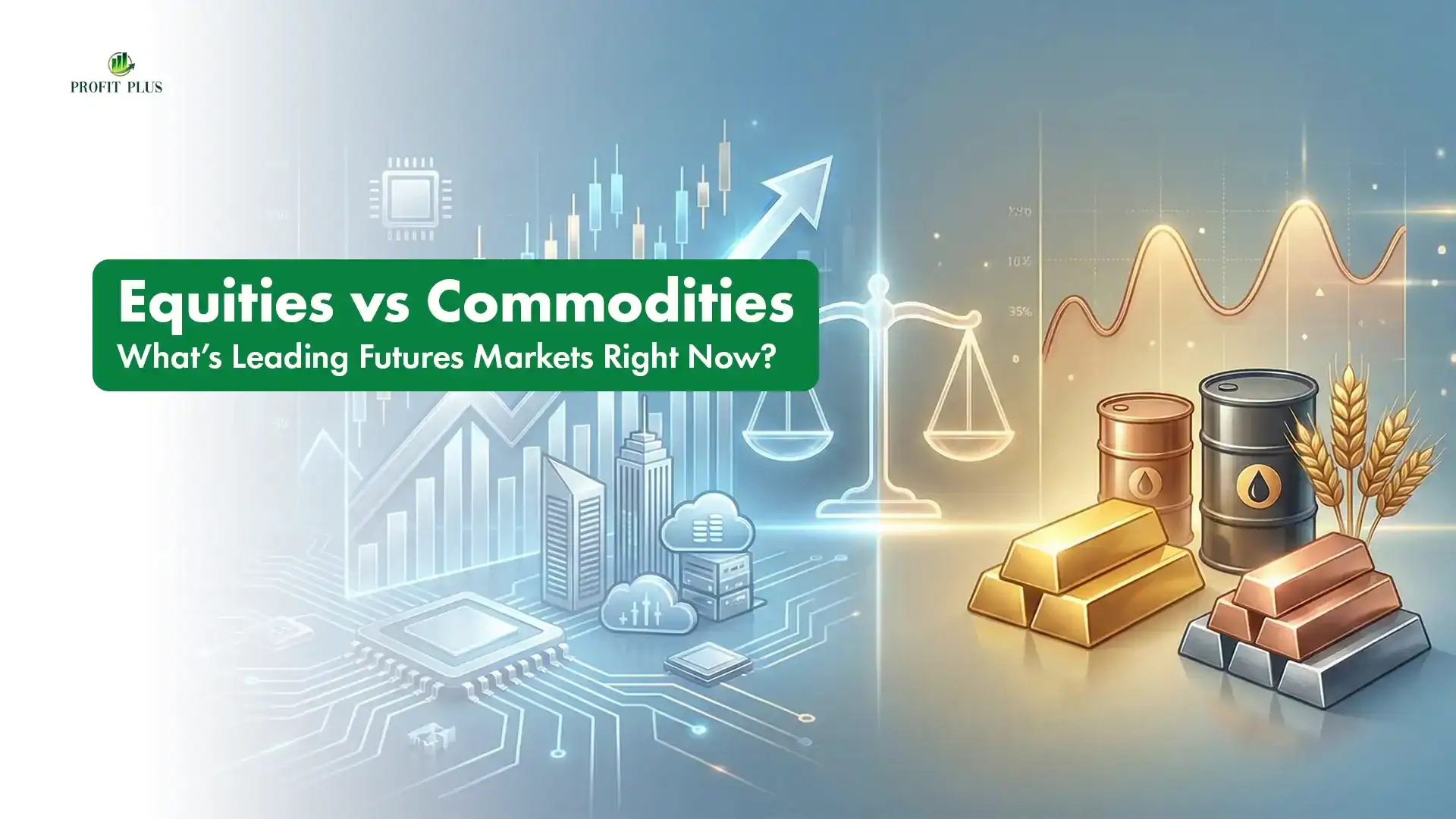
Futures markets are the battleground for global risk, macro trends, and trader sentiment. Whether you trade manually or use a futures trading bot, understanding whether equities or commodities are leading at a given moment can make the difference between profit and losses. In this post, written for readers of ProfitPlus.us, we explore what is steering futures markets today and how you can adapt.
What Determines Leadership: Equities or Commodities?
Futures are contracts that let traders bet on the future price of assets, from stock indexes to oil or gold. Which asset class leads often depends on:
- Economic conditions such as growth or uncertainty
- Investor sentiment such as risk-on or risk-off
- Supply and demand fundamentals for commodities or corporate earnings and innovation cycles for equities
As of late 2025, both equities and commodities are showing life but under different drivers.
Equities: When Tech, AI and Liquidity Drive the Move
Strong liquidity and broad participation
One reason for equities lead is liquidity. Futures tied to major stock indexes, such as E mini–S and P 500 futures, remain among the most traded contracts globally. This heavy trading volume ensures that equity futures often react quickly to earnings, policy signals, or major news.
Innovation and sector leadership
In 2025, technology and AI related companies have driven much of the upside in stock markets. Broad index rallies driven by investor enthusiasm for AI have pushed equity futures higher. Advances and market optimism have made equities, particularly in tech heavy indexes, a preferred choice for traders seeking growth.
Fast reaction to macro and sentiment
Equity futures often act as a barometer of investor confidence. When earnings are strong and macro-outlooks appear stable, these contracts tend to lead. Since index futures trade nearly 24 hours a day five days a week, they respond quickly to overnight or global developments, giving them an advantage over ETFs or cash equities.
Implication for traders and bots:
If you run a futures trading bot, equity futures allow automated strategies to capture rapid moves triggered by corporate or macro news. Thanks to strong liquidity, slippage and execution risks are often lower compared to many commodity futures.
Commodities: When Macro Risk, Supply, or Inflation Take Over
While equities often shine during growth periods, commodities step into the lead when macro uncertainty, inflation concerns, or supply and demand imbalances dominate.
Inflation, rate expectations, and safe haven demand
Commodities like gold benefit when investors fear inflation or anticipate changes in central bank policy. When equities become volatile or when economic growth looks uncertain, commodities, especially precious metals, attract safe haven flows. In 2025, gold and certain commodity classes have outperformed some equity benchmarks as investors look for protection.
Real demand and supply shocks affecting energy, metals, and raw materials
Some commodities depend on real-world supply and demand. Metals used in infrastructure or energy, especially those tied to green energy expansion or AI data centers, have seen rising demand. Futures for industrial metals and energy commodities continue to draw attention as global needs change. When supply constraints arise because of geopolitics, production issues, or natural disasters, commodity futures can lead strongly and independently from equity movements.
Diversification and hedging benefits
Commodity futures often move differently compared to equity futures. This makes them useful for hedging during periods of equity risk. Traders seeking to diversify or protect capital may shift into gold, oil, or other commodity futures when uncertainty rises.
Implication for traders and bots:
If your strategy involves macro risk hedging or diversification, adding commodity futures exposure can help. However, commodity futures can be more volatile and more heavily influenced by geopolitical or environmental factors, so strong risk management is essential.
Evidence from 2025: Mixed Signals and Active Markets
Recent market activity shows both patterns, with equity futures rallying and certain commodities showing strength or rebounding. Examples include:
- U.S. stock index futures showing strength as tech and AI enthusiasm lifts key indexes
- Commodity contracts in metals and energy gaining attention as global demand increases in areas such as green energy and supply chain restructuring
- Gold and industrial metals outperforming during periods of equity weakness or macro uncertainty
This indicates that there is no fixed leader. Leadership rotates based on market conditions, and smart traders follow the rotation.
How to Know Who Is Leading: A Simple Framework
Here is a practical checklist you can use manually or in a futures trading bot to spot whether equities or commodities are likely to lead next:
- Check macro indicators such as inflation expectations, central bank signals, currency strength, and geopolitical tension. Macro stress usually favors commodities.
- Watch earnings and sector trends. Strong tech and large cap earnings favor equity futures.
- Analyze volume and liquidity. High open interest and strong participation in index contracts signal equity leadership.
- Monitor commodity fundamentals such as supply changes, production cuts, inventory levels, and real demand.
- Watch correlations. If equities and commodities move together, broad sentiment is driving. If they diverge, leadership is rotating.
- Use strict risk controls. Whether manual or automated, position sizing and stop loss rules are essential.
What This Means for Traders and Futures Trading Bots
- Flexibility is critical. Market leadership switches between equities and commodities.
- Diversifying across both asset classes helps manage volatility.
- Using bots can improve timing, but the logic must account for macro conditions and cross market fundamentals.
- Staying data driven is far more effective than relying on predictions or hype.
For example, during a strong tech earnings environment, a bot may prioritize E mini S and P 500 futures. In periods where inflation or energy supply concerns dominate, the same bot may shift into gold or energy futures or hedge existing positions.
Conclusion
Equities lead when liquidity, innovation, and growth momentum dominate. Commodities lead when macro uncertainty, inflation pressure, or supply and demand shocks take center stage.
As a trader or operator of a futures trading bot, your strength comes from staying flexible, tracking market signals, and adjusting your strategy as leadership rotates. By monitoring macro indicators, liquidity shifts, sector trends, and commodity fundamentals, you can position yourself on the right side of the market.